EasyDev / Case study 01
From knowledge to product. Ready to launch.
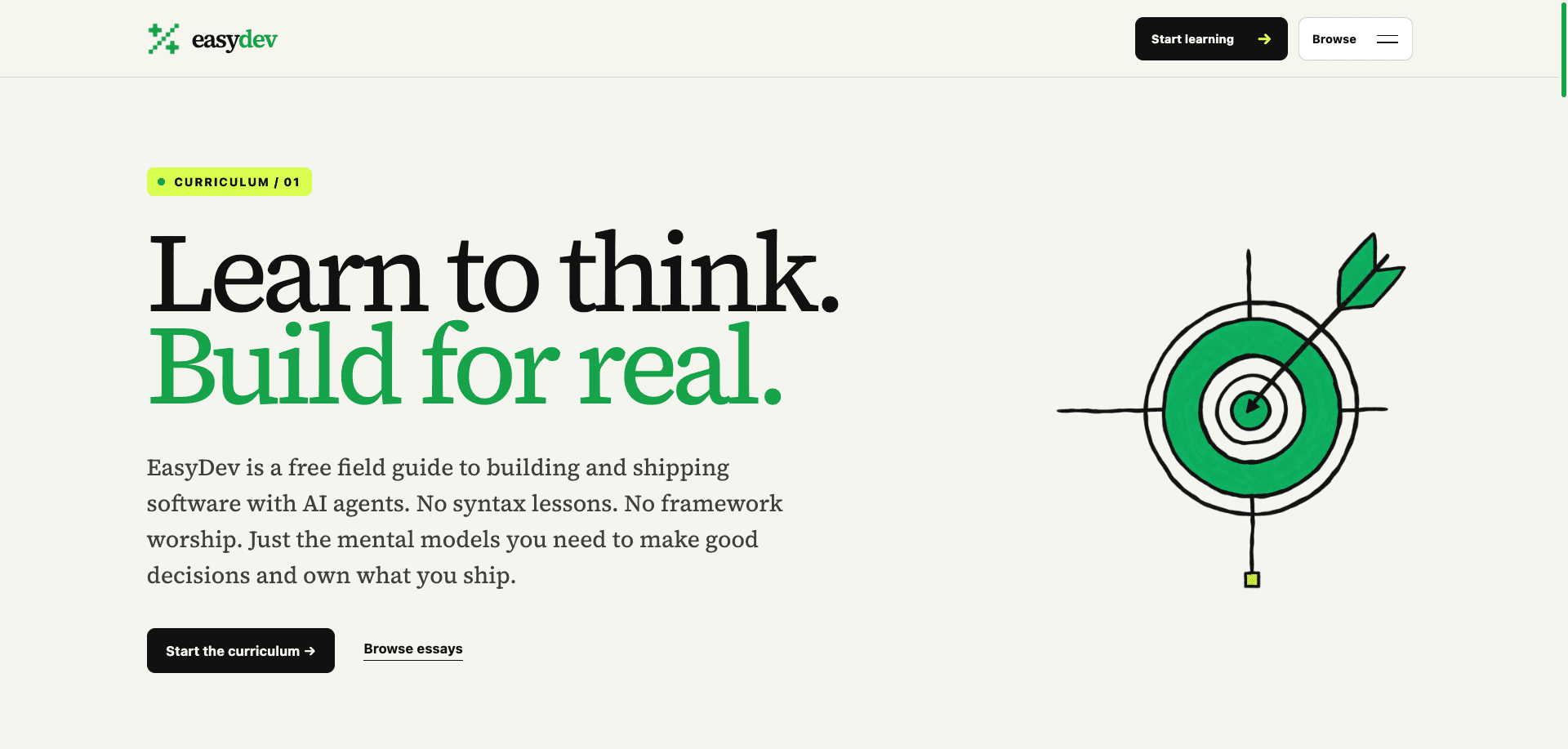
EasyDev is Nathan’s free field guide for developers building and launching software on their own with AI agents. It teaches judgment and architecture, not syntax. Workless helped turn Nathan’s carefully written curriculum into a real product people can use.
Visit easydev.ltd- Project
- EasyDev / easydev.ltd
- Role
- Concept, information architecture, content strategy, build
- Product
- Free developer field guide
- Status
- Live
The problem
AI agents can now write code. What they cannot do is decide what should be built, how it should be structured, or how to ship it safely. That gap—judgment, not syntax—is where many solo developers get stuck.
Most learning resources still teach frameworks and implementation. EasyDev set out to teach people how to think like a full-stack owner, so they can direct AI agents instead of being directed by them.
- Built for NathanA senior software engineer who already knows how to code and wants a sharper mental model for scoping, architecting, and shipping solo work with AI agents.
- Working aloneThere is no longer a team to debate architecture or review decisions with—every product choice is now his.
- Code is solved; judgment is notWriting software is no longer the problem. The problem is knowing what to write, how to structure it, and where to stop.
- Working with AI agents every dayAI agents are now part of Nathan's daily workflow—the question is no longer whether to use them, but who is directing whom.
Clarity before code
Workless starts with one belief: the more time spent making requirements as clear as a white paper, the less time is needed to code. EasyDev became proof of that belief applied to our own product.
Before any interface existed, the real work was defining what the site had to teach, who it was teaching, and how little surface area it needed to do that responsibly.
- 01 / NeedWhat does someone actually need to know to ship software alone?
- 02 / OrderWhat sequence turns disconnected knowledge into a usable mental model?
- 03 / BoundaryWhat is the smallest honest teaching surface without pretending to replace hands-on coding?
From knowledge to product
The knowledge was mapped before the interface: three tracks, nineteen modules, and roughly fifty-seven lessons. The curriculum moves from understanding the ask, through the full-stack map, to shipping and owning production software.
The first draft was then rewritten one level above syntax. Every lesson focuses on mental models and decisions, and closes with an open-ended action that readers apply to their own project.
- Track 01Understand the Ask—separate what a product needs from what a developer personally wants to build.
- Track 02The Full-Stack Map—connect frontend, backend, DevOps, and CI/CD into one architecture.
- Track 03Ship It Yourself—self-host, choose tools, and turn an idea into production-grade software.
- InterfaceA docs pattern with track, module, and lesson navigation, plus a suggested path for deliberate learning.
Built as a system
With the content architecture locked, the build moved quickly because the ambiguity was already resolved. The result is not one static page but four connected surfaces.
The management surface matters most: EasyDev's owner can adjust settings, upload material, and publish writing without touching code or a deployment pipeline. The product practices the same self-sufficiency it teaches.
- LandingA clear entry point positioned around Learn to Think. Build for Real.
- CourseworkA navigable track, module, and lesson system instead of one endless page.
- BlogLong-form writing for useful material that does not belong in a fixed curriculum slot.
- ManagementA separate admin experience for routine publishing and product updates.
The result
EasyDev is live at easydev.ltd as a free field guide to product judgment, architecture, infrastructure, and production ownership for developers working with AI agents.
It demonstrates the Workless process under real pressure: requirements clarified to white-paper depth, information architecture treated as the product decision, and an interface chosen because it served the knowledge—not because it looked fashionable.
- RequirementsResolved deeply before design or development began.
- ArchitectureThe structure of the knowledge became the foundation of the product.
- ExecutionClarity first made the final build faster, more coherent, and easier to keep shipping.